Average improvement on Tau2-bench retail tasks across 6 SOTA LLMs.
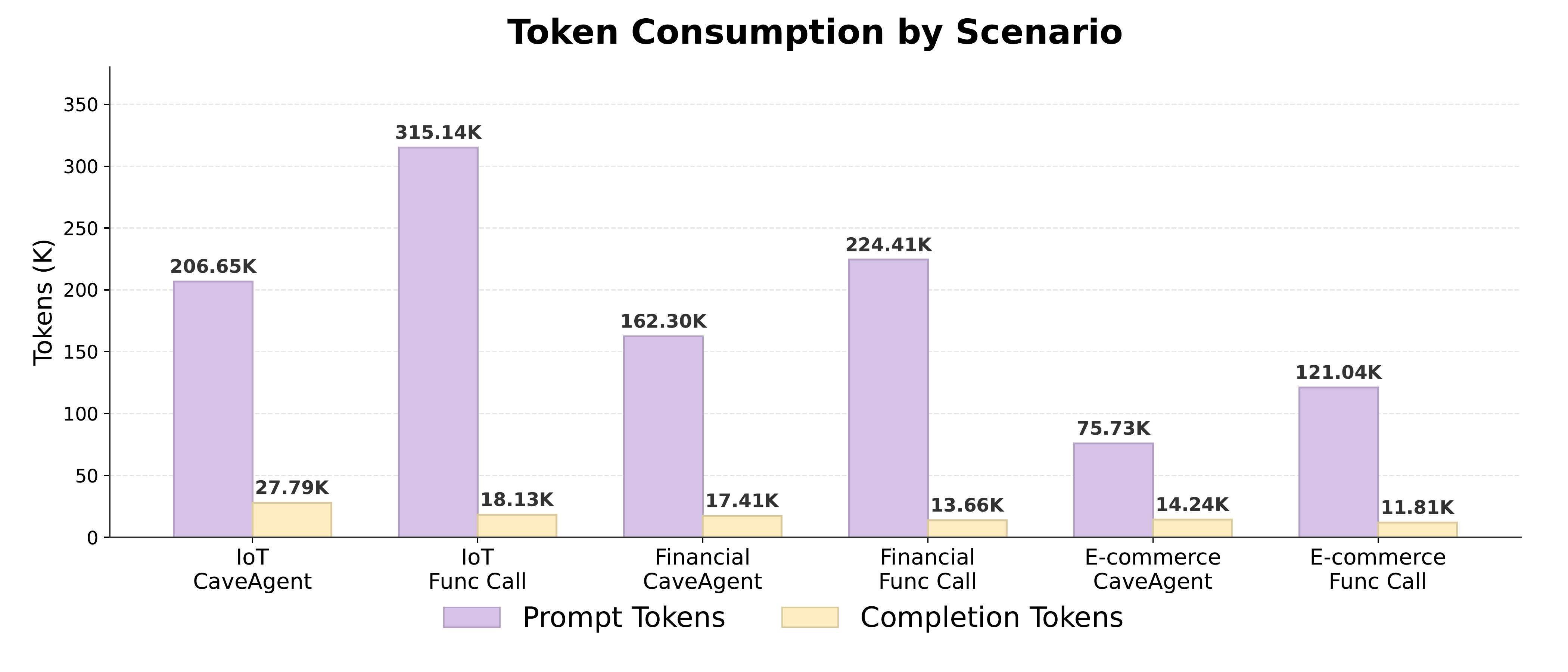
Less total token consumption by delegating state to persistent runtime.
Token reduction on data-intensive tasks via runtime state management.
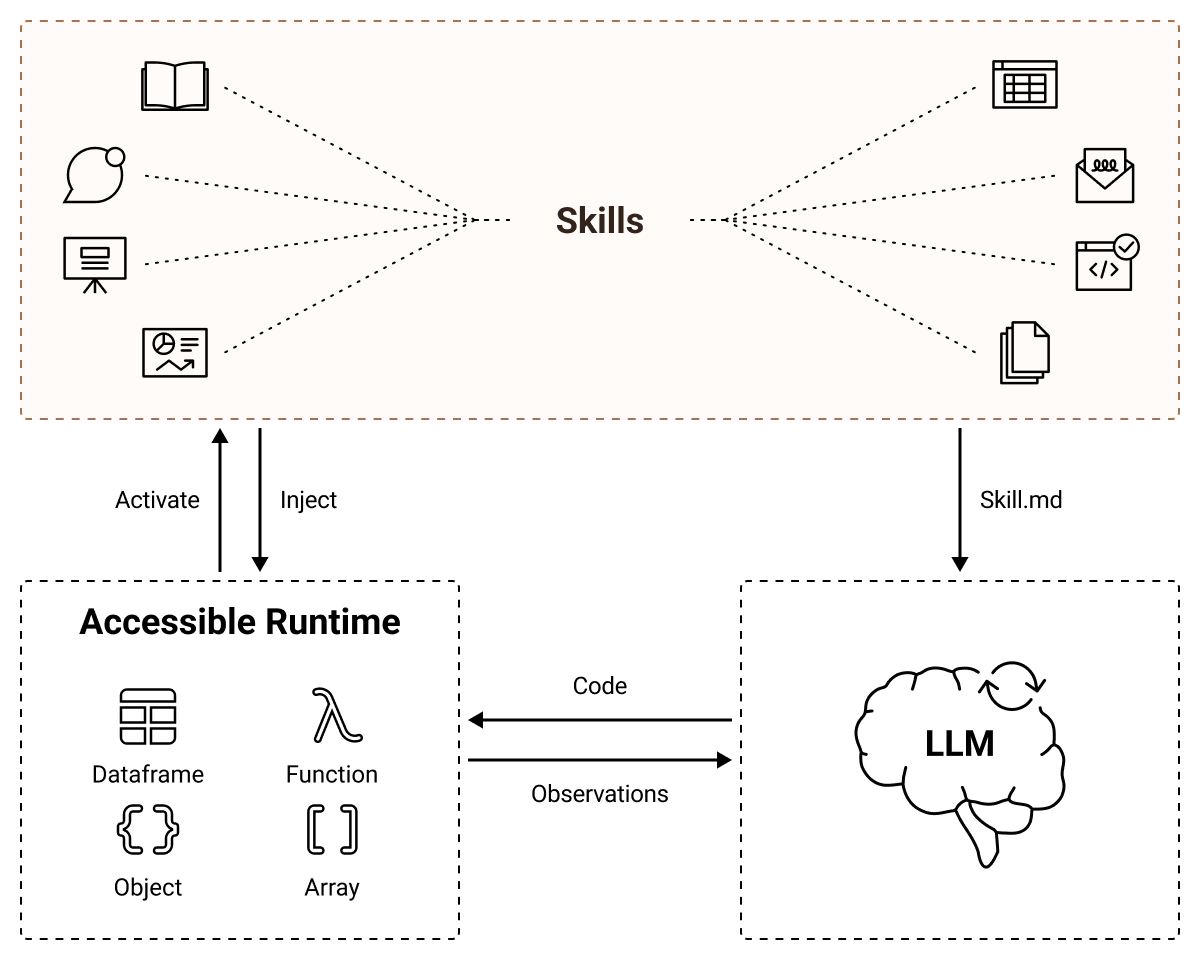
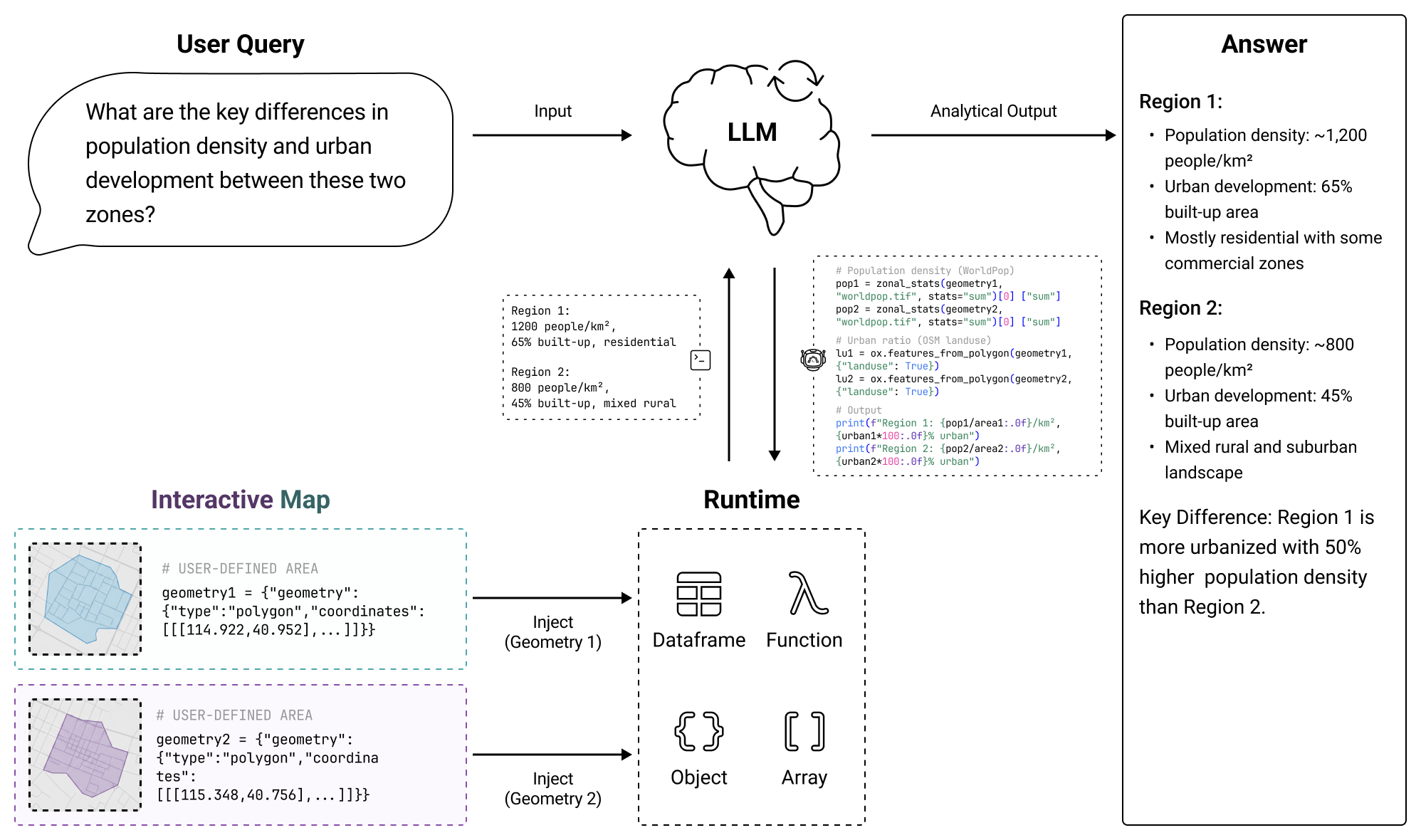
LLM-based agents are increasingly capable of complex task execution, yet current agentic systems remain constrained by text-centric paradigms that struggle with long-horizon tasks due to fragile multi-turn dependencies and context drift. We present CaveAgent, a framework that shifts LLM tool use from "LLM-as-Text-Generator" to "LLM-as-Runtime-Operator." CaveAgent introduces a dual-stream architecture: a semantic stream for lightweight reasoning and a runtime stream backed by a persistent Python environment for stateful execution.
Rather than treating the LLM's text context as the primary workspace, CaveAgent elevates the persistent runtime as the central locus. Beyond leveraging code generation to resolve interdependent sub-tasks in a single step, CaveAgent introduces Stateful Runtime Management: it injects, manipulates, and retrieves complex Python objects (e.g., DataFrames, database connections) that persist across turns. CaveAgent further provides a runtime-integrated skill management system that extends the Agent Skills open standard.
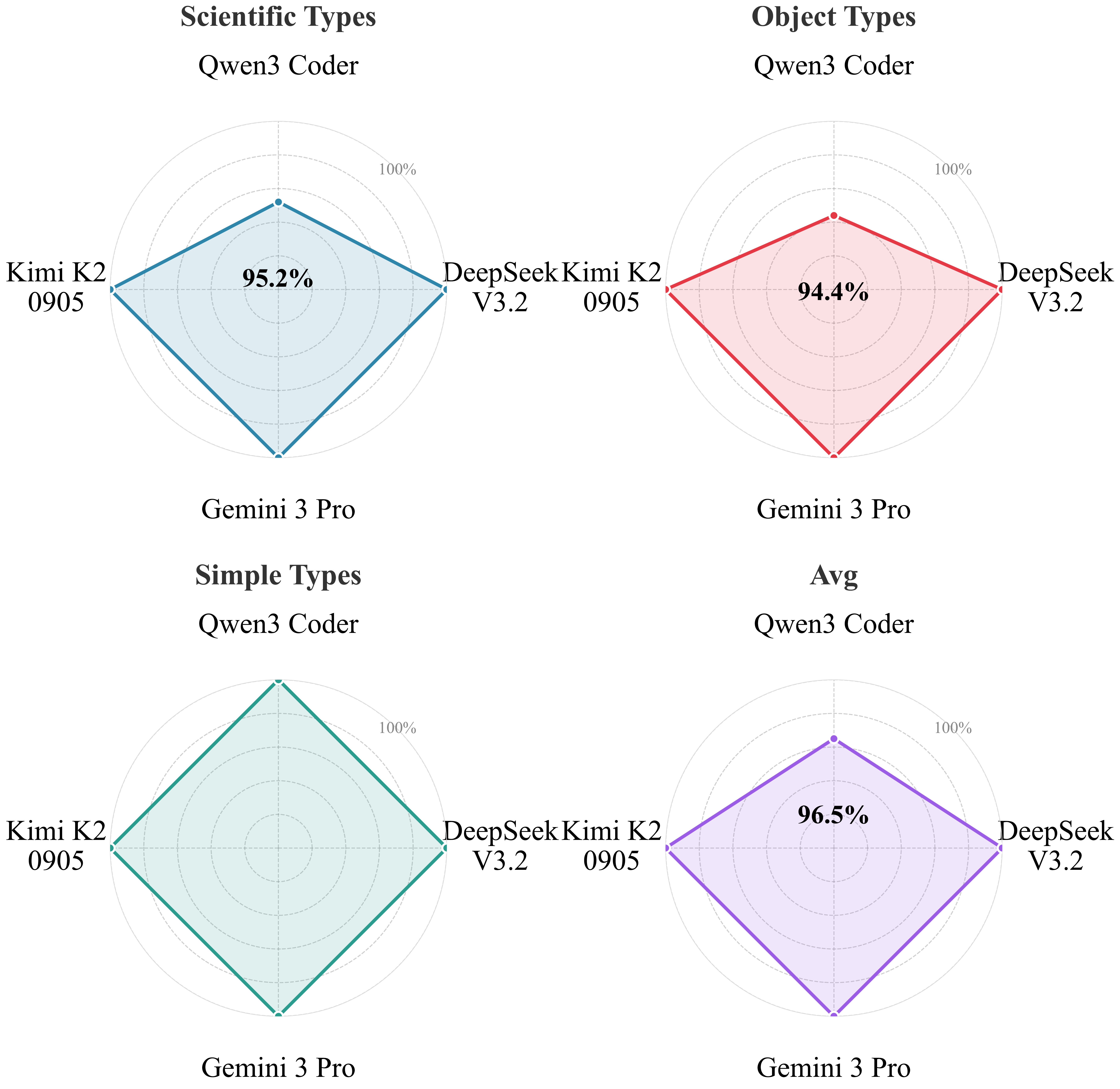
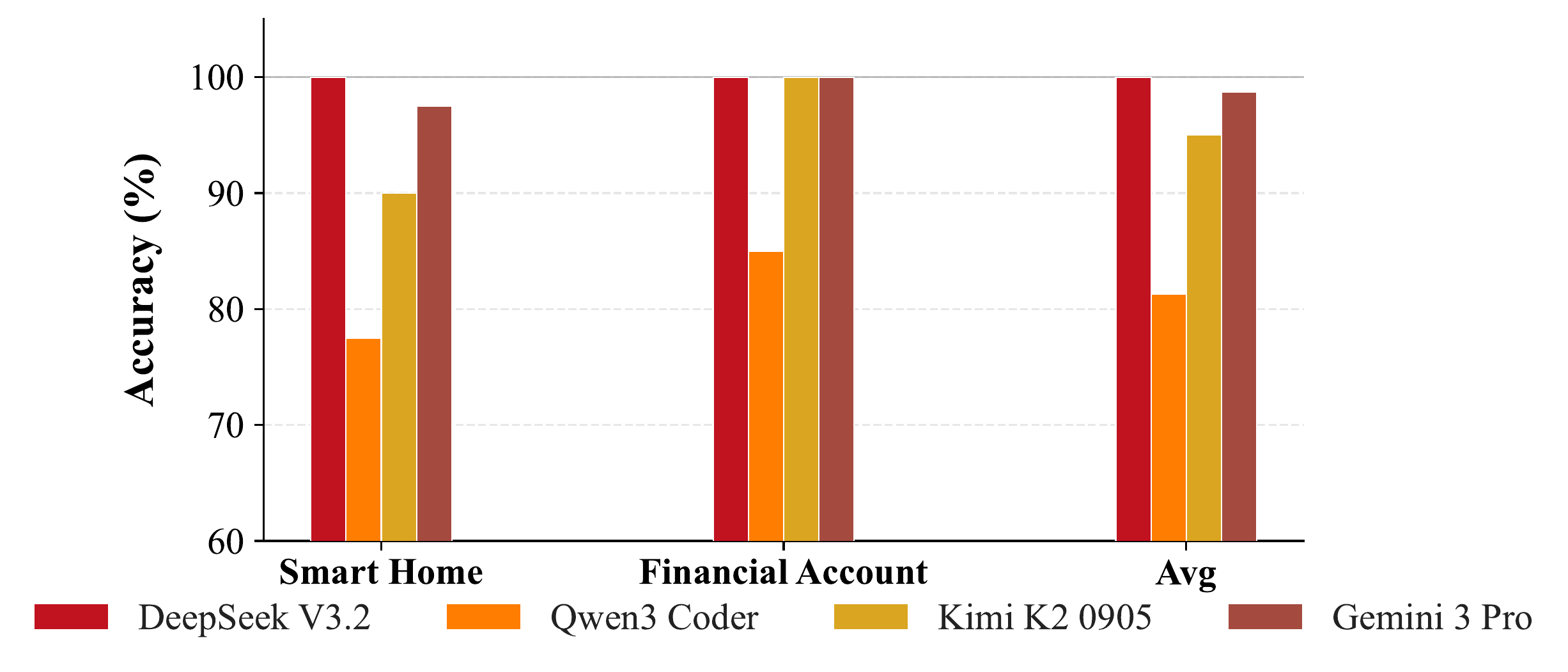
Evaluations on Tau2-bench and BFCL across six SOTA LLMs demonstrate consistent improvements: +10.5% success rate on retail tasks, 28.4% reduction in total token consumption, and 59% token reduction on data-intensive tasks. The accessible runtime state further provides programmatically verifiable feedback, enabling automated evaluation and reward signal generation for Reinforcement Learning with Verifiable Rewards (RLVR).
Separates lightweight semantic reasoning from persistent runtime state, eliminating context drift in long-horizon tasks.
Inject, manipulate, and retrieve complex Python objects (DataFrames, DB connections) that persist across turns.
Extends Agent Skills open standard with progressive disclosure and direct runtime injection.
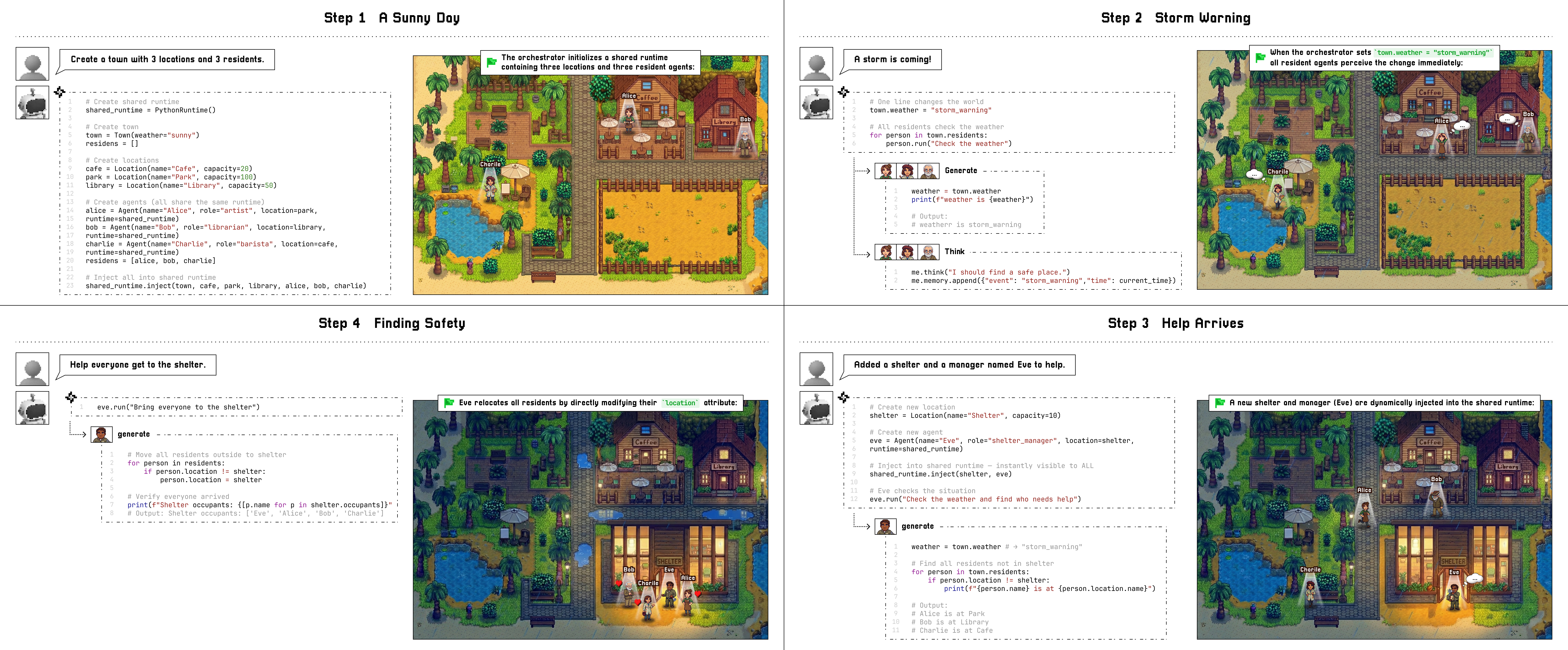
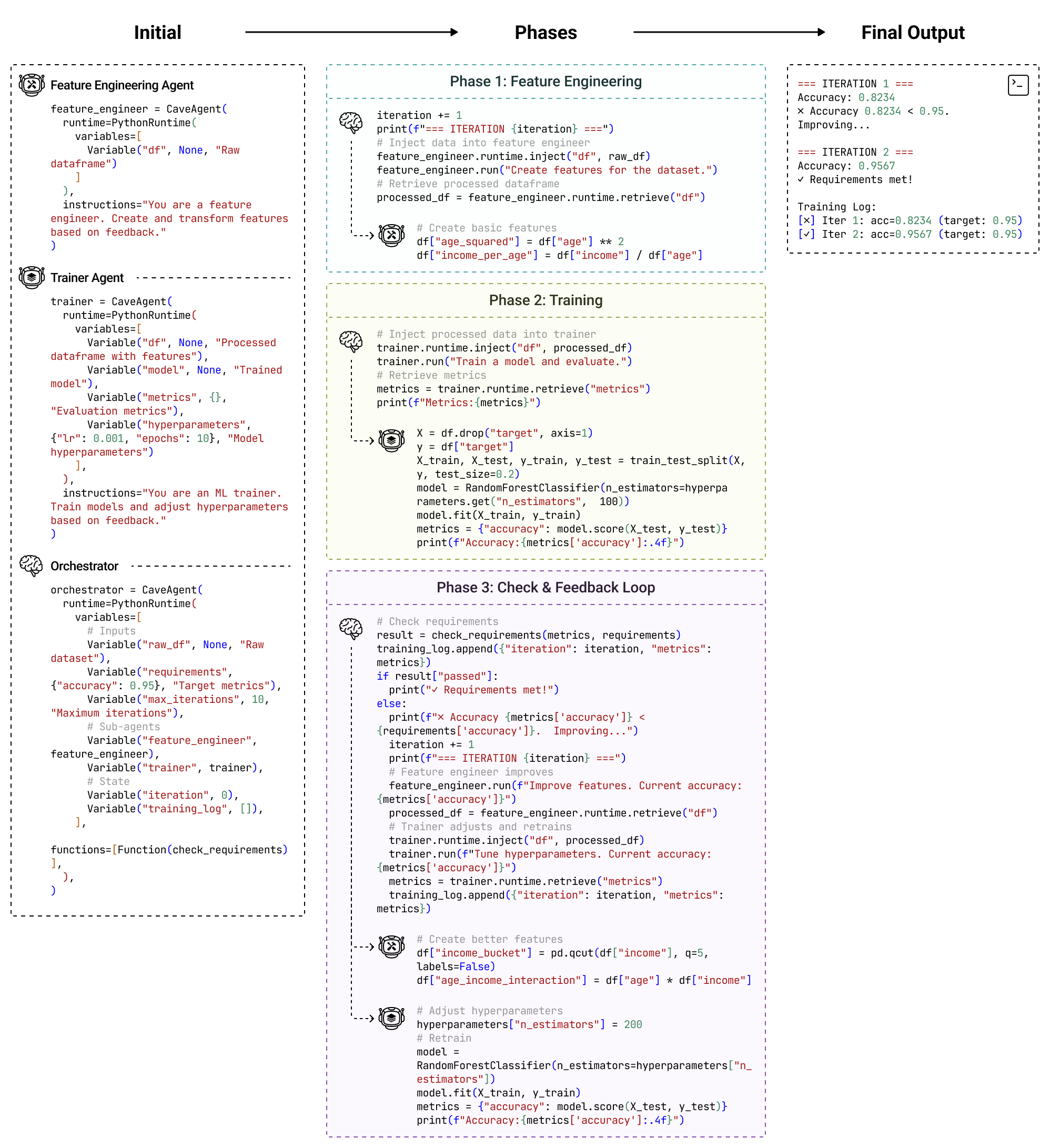
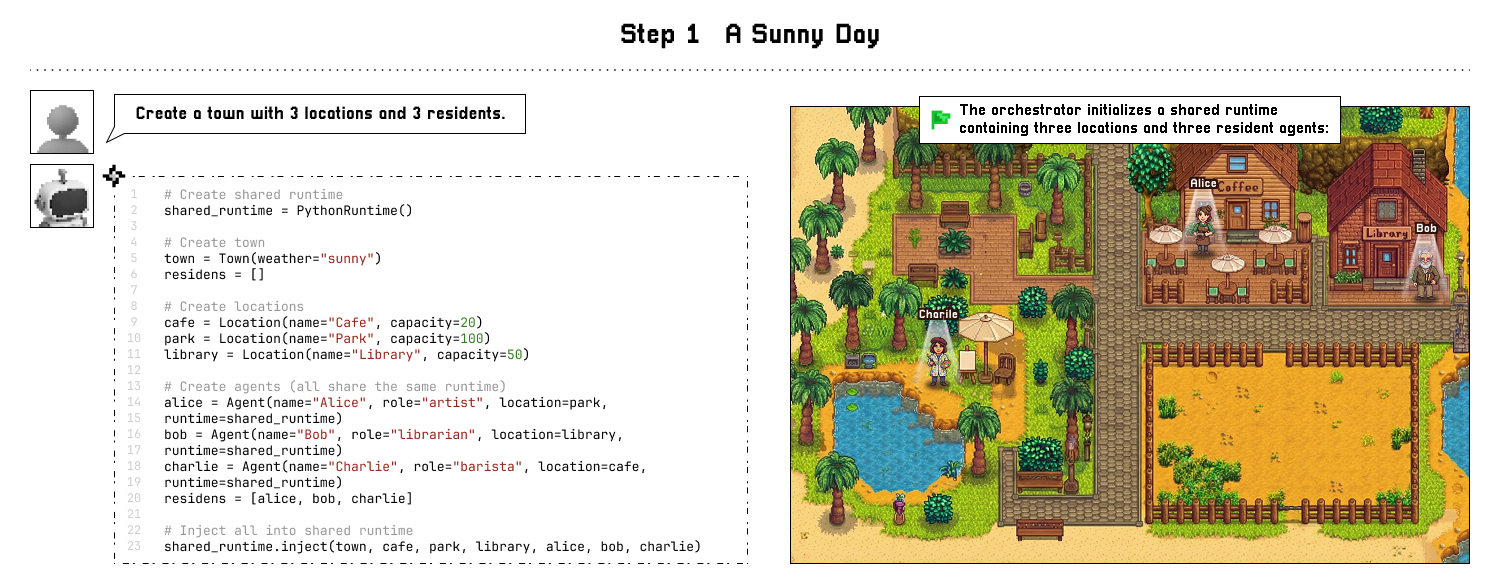
Multiple agents share a single runtime — when one agent changes the world, all others perceive it immediately through direct object reference.
The orchestrator creates a shared runtime with 3 locations and 3 resident agents — all sharing one persistent Python environment.
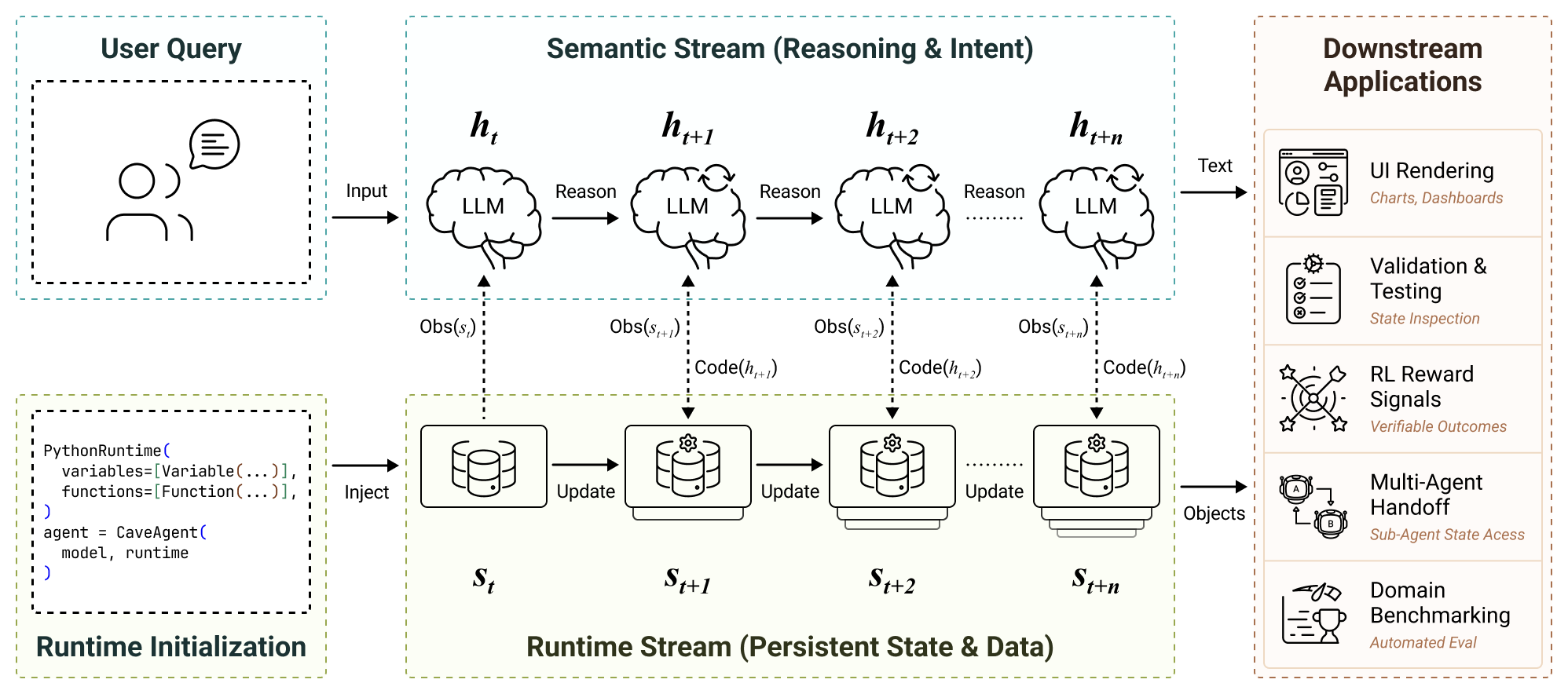
Dual-Stream Architecture: Semantic Stream for reasoning, Runtime Stream for persistent state management.
Click an example, then step through the workflow.
Click each turn to see how CaveAgent maintains persistent state across interactions.
Thermostat
18°C
Door
Locked
Lights
Off
Camera
Off
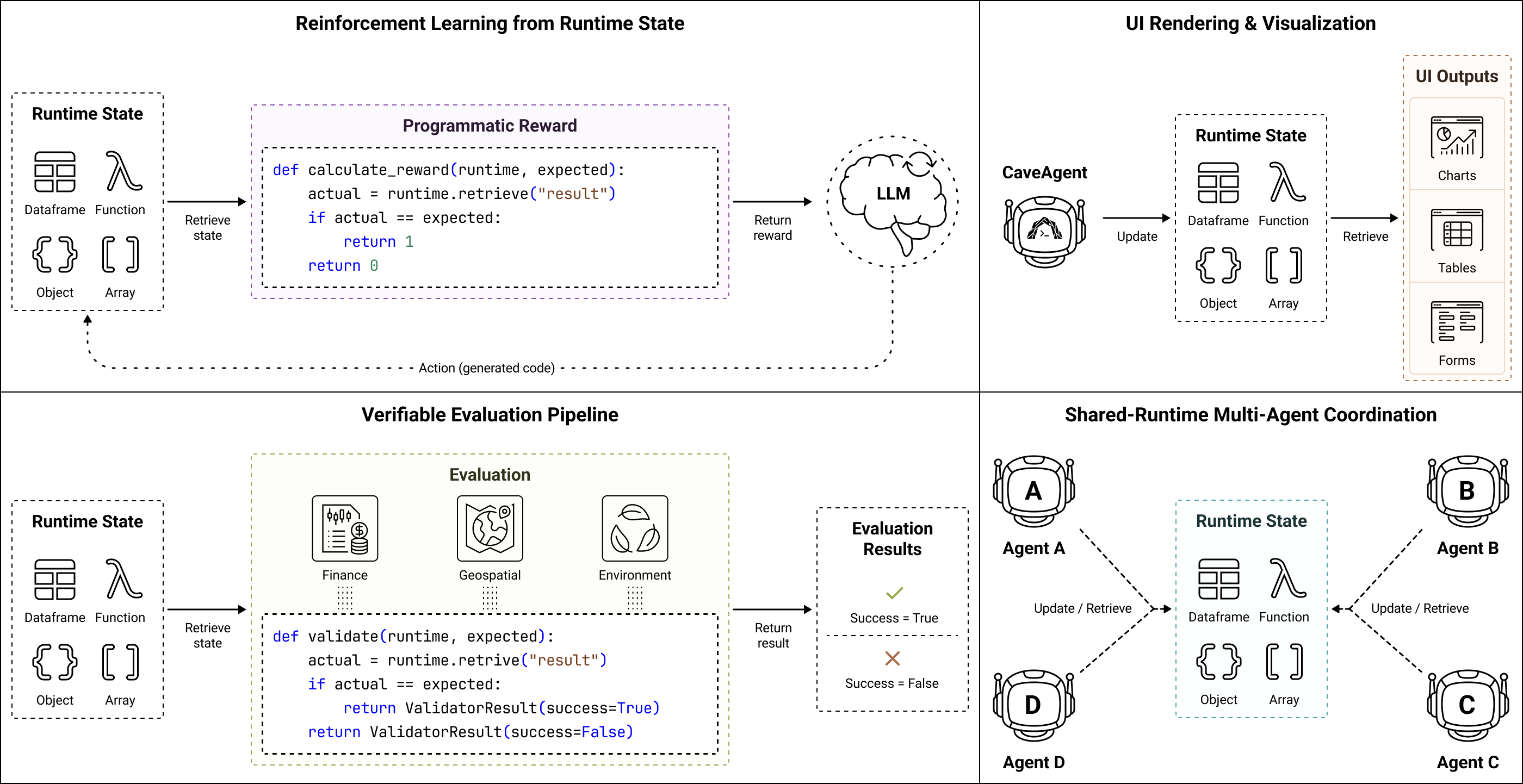
Key Advantages: UI Rendering, Validation, RL Rewards, Multi-Agent Handoff, Benchmarking
Performance on Tau2-bench (Retail domain) across 6 SOTA LLMs. CaveAgent achieves +10.5% average success rate improvement.
| Model | Baseline SR | CaveAgent SR | Improvement |
|---|---|---|---|
| GPT-4o | 31.0% | 37.0% | +6.0% |
| Claude 3.5 Sonnet | 28.5% | 40.5% | +12.0% |
| Gemini 2.0 Flash | 21.5% | 31.5% | +10.0% |
| Gemini 2.5 Pro | 38.5% | 46.5% | +8.0% |
| DeepSeek-V3 | 20.5% | 33.5% | +13.0% |
| Qwen 2.5 72B | 19.0% | 33.0% | +14.0% |
| Average | 26.5% | 37.0% | +10.5% |
SR = Success Rate. Full results including Airline domain available in the paper.
pip install 'cave-agent[all]'import asyncio
import pandas as pd
from cave_agent import CaveAgent
from cave_agent.runtime import PythonRuntime, Variable
from cave_agent.models import LiteLLMModel
model = LiteLLMModel(
model_id="model-id",
api_key="your-api-key",
custom_llm_provider="openai"
)
async def main():
# Inject a real DataFrame into the runtime
df = pd.DataFrame({
"product": ["Widget A", "Gadget B", "Sensor C"],
"revenue": [2400000, 1800000, 1200000],
})
runtime = PythonRuntime(
variables=[Variable("sales", df, "Sales data")],
)
agent = CaveAgent(model, runtime=runtime)
await agent.run("What is the total revenue?")
# Retrieve the real DataFrame — not text
result = runtime.retrieve("sales")
print(type(result)) # <class 'pandas.DataFrame'>
asyncio.run(main())@article{ran2026caveagent,
title={CaveAgent: Transforming LLMs into Stateful Runtime Operators},
author={Ran, Maohao and Wan, Zhenglin and Lin, Cooper and Zhang, Yanting and others},
journal={arXiv preprint arXiv:2601.01569},
year={2026}
}